Topographic constraints shape brain-like
component structure in auditory models

CCN 2026 — 9th Annual Conference on Cognitive Computational Neuroscience

Haider Al-Tahan1,2
Mayukh Deb1,2
Jenelle Feather3,4,5
N. Apurva Ratan Murty1,2

1 Cognition and Brain Science, School of Psychology, Georgia Tech    2 Computational Cognition, Georgia Tech
3 Center for Computational Neuroscience, Flatiron Institute, Simons Foundation    4 Psychology Department, Carnegie Mellon University    5 Neuroscience Institute, Carnegie Mellon University


Georgia Tech

OpenReview Code BibTeX

Abstract

If topography is a fundamental feature of the brain, it should influence both how neurons are arranged in space (i.e. explain brain maps) and how information is structured within the neural population. The human auditory cortex provides a strong, but previously underused test for the latter idea. Neural responses measured with both fMRI and ECoG can be decomposed into interpretable components corresponding to sound categories such as speech, music, and song, offering a view of how sound information is partitioned in the brain. Here we ask whether introducing topographic constraints into the training of audio neural network models shapes their internal representations to better match the component structure observed in the brain. We introduce TopoAudio, a new class of topographic auditory models that incorporate wiring-length constraints and encourage nearby units on a two-dimensional cortical sheet to develop similar response tuning. Despite these additional constraints, TopoAudio achieves comparable performance on standard speech and environmental sound classification tasks and matches non-topographic models in predicting human fMRI responses. Crucially, topographic models develop more compact internal representations, and their inferred components align more closely with those derived from human ECoG recordings. These results provide initial evidence that topography offers a general mechanism for producing biologically aligned internal representations in artificial neural networks.


Overview: TopoAudio

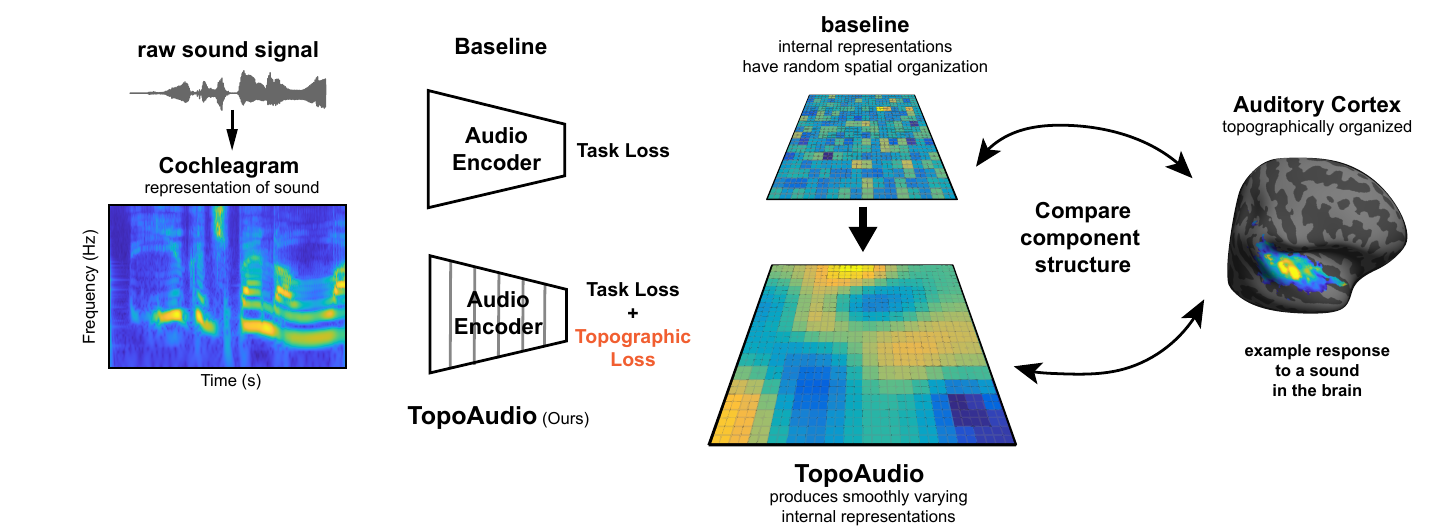
Figure 1 — TopoAudio Pipeline Overview

Fig. 1. TopoAudio: Topographic auditory models. Raw sound waveforms are transformed into cochleagrams and passed through the CochResNet50 backbone. The baseline model is trained with only a task loss; TopoAudio adds a spatial smoothness constraint (TopoLoss). We compare the component structure of model internal representations against those inferred from human auditory cortex.


Key Findings

Finding 1: TopoAudio preserves task performance. TopoAudio achieves classification accuracy on ESC-50, NSynth, and Speech Commands that is comparable to non-topographic baselines (<1% drop), even as topographic smoothness increases substantially.
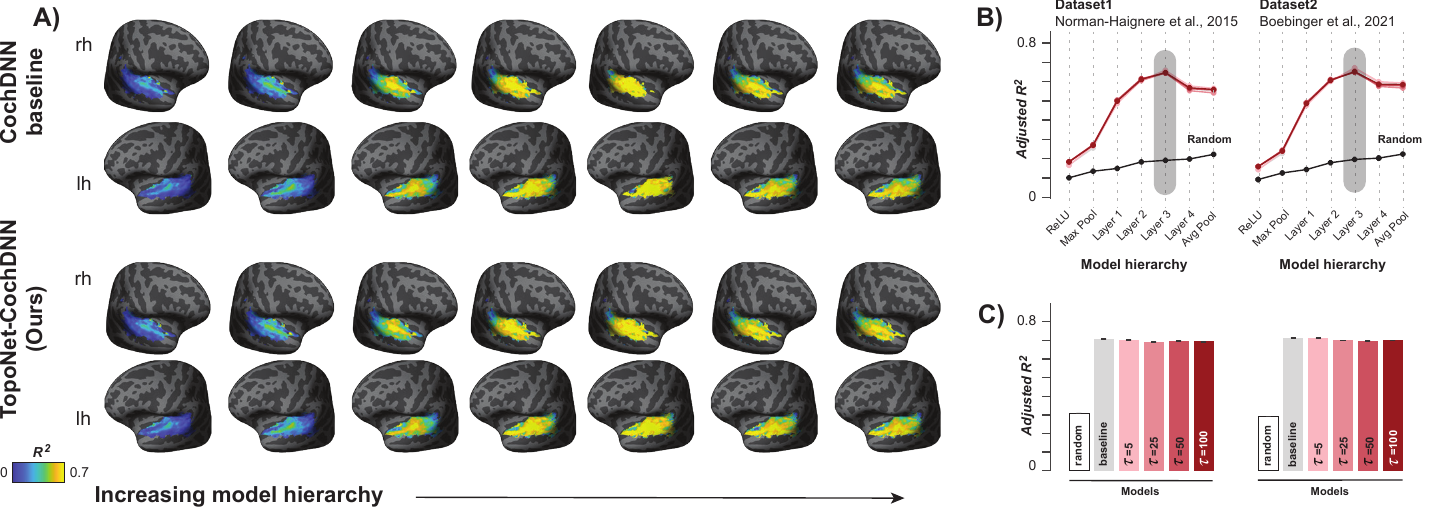
Finding 2: TopoAudio maintains brain predictivity. TopoAudio predicts human auditory fMRI responses (NH2015, B2021) with equally high accuracy across all cortical layers and regions of interest, matching non-topographic baselines.
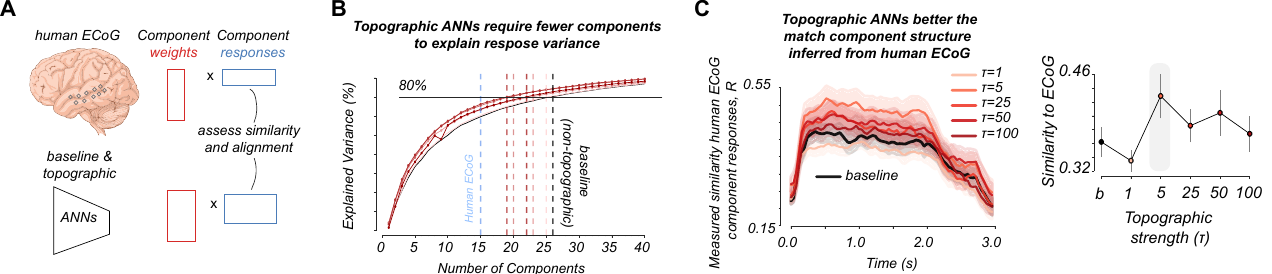
Finding 3: TopoAudio requires fewer ICA components. Topographic constraints reduce the number of ICA components needed to explain 80% of response variance (e.g., 26 components for baseline vs. 20 for τ = 25).
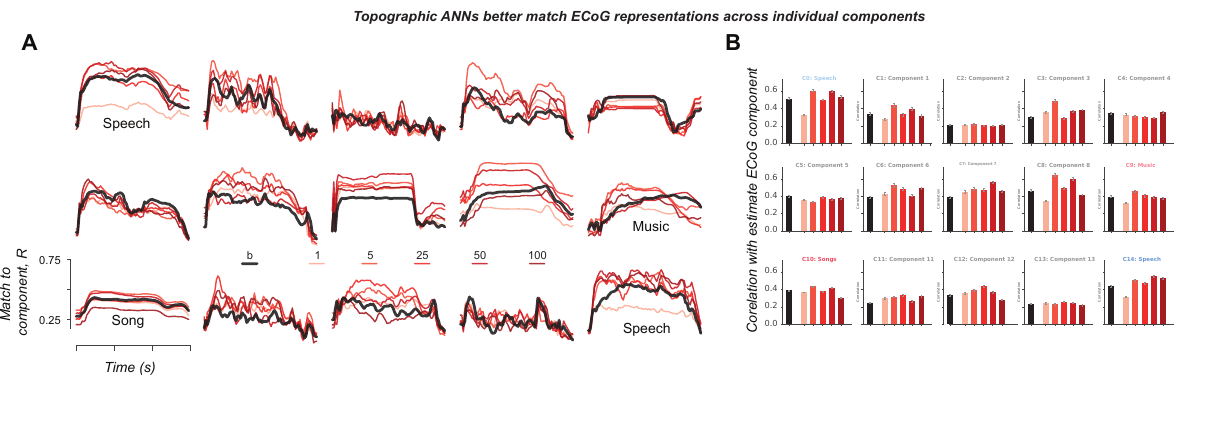
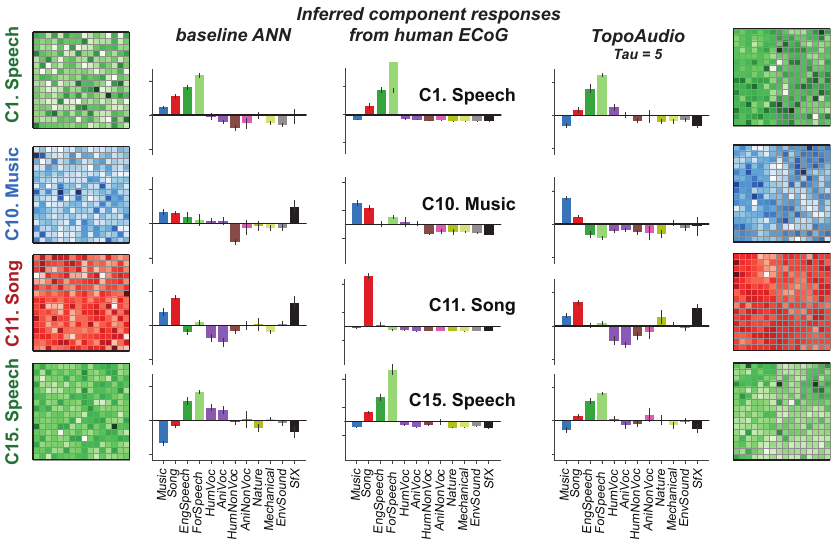
Finding 4: TopoAudio shows improved alignment with human ECoG. TopoAudio recovers selectivity for music, speech, and song, with components showing significantly improved correlation with the 15 components derived from human ECoG recordings.
Finding 5: TopoAudio recovers selectivity for music, speech, and song. Topographic constraints enable the model to develop components with clear category selectivity matching those seen in human auditory cortex — including dedicated components for speech, music, and song that are absent or diffuse in non-topographic baselines.
<1% drop in task accuracy
with topography
26 → 20 Fewer ICA components
needed at 80% variance
0.32 → 0.46 Improved ECoG alignment (R)
baseline vs. TopoAudio
τ = 5 optimal topographic
strength (sweet spot)


TopoAudio Preserves Task Performance

Topography (τ) ESC-50 NSynth Speech Commands Smoothness
Baseline81.6998.2986.68−0.002
τ = 581.4698.5086.880.16
τ = 2580.6298.3987.890.22
τ = 5080.8498.3687.570.50
τ = 10080.3298.7286.850.62
Topographic Avg.80.7998.4987.330.38

Introducing topographic constraints (τ) substantially increases representational smoothness with only modest changes in classification performance across all three benchmarks.


TopoAudio Maintains Brain Predictivity

Figure 2 — Brain Predictivity (fMRI)

Fig. 2. Topographic auditory models maintain overall voxel-wise brain predictivity. Both baseline and TopoAudio models achieve comparable levels of predictivity across all fMRI datasets and cortical regions of interest (early tonotopic, pitch-selective, higher-order music/speech areas). The five TopoAudio curves are virtually superimposed with the baseline.


TopoAudio Produces More Compact & Brain-Aligned Component Structure

Figure 3 — Component Analysis & ECoG Alignment

Fig. 3. Left: Schematic of the component alignment procedure. Middle: Topographic ANNs require fewer components to explain 80% of response variance. Right: Correlation time courses reveal stronger alignment between topographic models and human ECoG across the 0–3 s stimulus window. Statistical significance: P<0.05 at τ = 5, 50; P=0.07 at τ = 25 (Fisher z post-hoc paired t-tests).


TopoAudio Shows Improved Per-Component Alignment with Human ECoG

Figure 4 — Per-Component Alignment

Fig. 4. Topographic ANNs better match ECoG representations across individual components. Across all 15 matched components, topographic models typically equal or outperform the baseline. A modest topographic strength (τ = 5) most consistently improves brain alignment without over-constraining the representation.


TopoAudio Recovers Selectivity for Music, Speech and Song

Figure 5 — Category Tuning Profiles

Fig. 5. TopoAudio recovers selectivity for music, speech and song. Category response profiles for speech (C1, C15), music (C10), and song (C11) are shown for human ECoG (center), the baseline ANN (left), and TopoAudio τ = 5 (right). TopoAudio recovers speech, music, and song selectivity more cleanly than the baseline. Corresponding weight maps show spatially contiguous unit organization in the topographic model vs. diffuse organization in the baseline.


Summary: Baseline vs. TopoAudio

Metric Baseline TopoAudio
Engineering tests (accuracy)
Brain prediction (fMRI)
Spatial smoothness
ICA components (fewer = better) More (~26)Fewer (~20)
ECoG component alignment Worse (~0.32)Improved (~0.46)

Both models achieve comparable task performance and fMRI predictivity, but topographic models learn smoother representations, fewer ICA components, and stronger alignment with brain-derived components, indicating more brain-like internal structure.


Acknowledgements

This work was supported in part by the NIH Pathway to Independence Award (R00EY032603), NSF Nexus (Allocation number: SOC250049), a startup grant from Georgia Tech to N.A.R.M., and an NSERC Postgraduate Scholarship – Doctoral. We thank everyone at Murty Lab for their feedback and support.


BibTeX

@inproceedings{ anonymous2026topographic, title={Topographic constraints shape brain-like component structure in auditory models}, author={Anonymous}, booktitle={9th Annual Conference on Cognitive Computational Neuroscience}, year={2026}, url={https://openreview.net/forum?id=sELPprz4PR} }